Three Electric Fields for One Uniformly Charged Universe
A common misconception is that a universe uniformly filled with charge must produce a zero electric field everywhere because equal amounts of charge exist in all directions. We examine this idea using Gauss’ law by constructing infinite charge distributions that respect different symmetries from the outset. When the distribution is built with spherical symmetry by expanding uniformly charged spheres, Gauss’ law yields

Constructing the universe instead through an infinitely long charged cylinder whose radius increases to infinity gives

while stacking infinitely large charged planes produces

The electric field therefore depends on the symmetry used to construct the uniform distribution. The reason is that the total charge enclosed within a distance grows differently in the three constructions, leading to different electric field strengths even though the charge density is uniform. This example illustrates a subtle feature of applying Gauss’ law to infinite charge distributions and provides a useful pedagogical demonstration of the role symmetry plays in determining electric fields.
1. Introduction
In introductory electricity and magnetism courses, Gauss’ law is commonly applied to highly symmetric charge distributions such as uniformly charged spheres, infinitely long cylinders, and infinitely large planes (Griffiths 2023; Guisasola et al. 2008; Saini & Kohandani 2025). In each case the symmetry of the charge distribution determines the form of the electric field and allows the field magnitude to be obtained through an appropriate choice of Gaussian surface.
A natural conceptual question arises when these ideas are extended to a universe uniformly filled with charge. A common argument suggests that the electric field must vanish everywhere because equal amounts of charge surround any point in all directions, leading to cancellation of the electric field. However, applying Gauss’ law carefully shows that this conclusion is not generally correct when the charge distribution is constructed respecting specific symmetries.
To explore this issue, we consider three ways of constructing an infinitely large universe filled uniformly with charge while maintaining symmetry at every stage of the construction. In the first case, the universe is built by filling increasingly larger spheres centered at the origin. In the second case, the universe is constructed using an infinitely long cylinder whose radius increases without bound. In the third case, the universe is assembled by stacking infinitely large thin planes of charge. In each construction the charge density remains uniform, but the symmetry used to extend the distribution to infinity differs.
Applying Gauss’ law to these three constructions yields different electric field strengths at the same distance from the origin. The reason is that the total charge enclosed within a distance grows differently depending on the symmetry used to construct the charge distribution. As a result, the electric field obtained from Gauss’ law reflects the symmetry of the construction even though the charge density is uniform throughout space. This illustrates a subtle but instructive aspect of applying Gauss’ law to infinite charge distributions and highlights the important role that symmetry assumptions play in determining electric fields.
2. Symmetry constructions
In the constructions considered below, the charge distribution is extended to infinity while preserving a particular symmetry (spherical, cylindrical, or planar) at every stage. The electric field obtained from Gauss’ law therefore reflects the symmetry used to construct the uniformly charged universe.
2.a. Spherical symmetry
Let us imagine filling the entire universe uniformly with charge by constructing increasingly larger spheres whose center lies at the origin. At every stage the charge density remains constant and the configuration preserves spherical symmetry. Applying Gauss’ law to a spherical Gaussian surface of radius r gives

Solving for the electric field magnitude yields
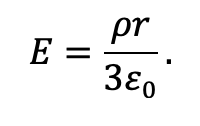
The electric field is radial and increases linearly with distance from the origin. The characteristic volume of the universe constructed in this manner is

with

corresponding to an infinitely large sphere.
2.b. Cylindrical symmetry
Next consider constructing the universe using cylindrical symmetry. Imagine filling space with an infinitely long uniformly charged cylinder whose radius increases without bound while its axis remains fixed. In contrast to the spherical construction, an infinite extent along the axis is present from the outset.
Applying Gauss’ law to a cylindrical Gaussian surface of radius r and length L gives

These yield

At a distance from the axis the electric field again grows linearly with distance, but its magnitude is larger than in the spherical case. The difference arises because the amount of charge included within distance r grows differently when the universe is constructed with cylindrical symmetry. If the cylinder extends a distance r in both directions along the axis, its characteristic length is 2r, giving a characteristic volume

with

This volume exceeds that of the spherical construction,

2.c. Planar symmetry
Finally, consider constructing the universe by stacking infinitely large, uniformly charged planes. A convenient Gaussian surface in this case is a box whose top and bottom faces each have area A and whose height is 2r.
Applying Gauss’ law gives

which leads to

Thus, the electric field grows linearly with distance from the reference plane and is larger than in both the spherical and cylindrical constructions. If the Gaussian box is taken to be a cube of height 2r, its sides are also of length 2r, giving a characteristic volume

with

The ordering of the characteristic volumes is therefore

3. Symmetry and the growth of enclosed charge
The differences in electric field strength obtained in the previous sections arise from the way the enclosed charge grows with distance when the charge distribution is constructed with different symmetries. Although the charge density is uniform in all three cases, the amount of charge contained within a distance r depends on the geometry used to extend the distribution to infinity.
For spherical symmetry, the enclosed charge within radius r is proportional to the volume of a sphere,

so the charge grows as r cubed. For cylindrical symmetry, the enclosed charge within radius r grows with the cross-sectional area of the cylinder and therefore scales as r squared. In the planar construction, where the universe is built by stacking charged planes, the enclosed charge within a distance r grows only linearly with r.
Gauss’ law relates the electric field to the ratio of the enclosed charge to the area of the Gaussian surface. Because the enclosed charge increases at different rates depending on the symmetry of the construction, the resulting electric field strengths differ even though the charge density is the same in all three cases. In each construction the electric field grows linearly with distance from the origin, but the proportionality constant reflects the symmetry used to extend the charge distribution to infinity.
This illustrates that when Gauss’ law is applied to an infinite uniformly charged universe, the resulting electric field depends on how the distribution is constructed while preserving symmetry. The symmetry determines how rapidly charge accumulates with distance and therefore determines the electric field strength.
4. Why is E = 0 is not consistent with Gauss’ law
A common argument suggests that the electric field in a universe uniformly filled with charge must vanish everywhere because equal amounts of charge surround any point in all directions. If this reasoning were correct, the electric field would satisfy
E = 0
everywhere in space. However, this result is incompatible with Gauss’ law. In differential form Gauss’ law states

For a uniformly charged universe the charge density is constant and nonzero. The divergence of the electric field must therefore also be nonzero. However, if E = 0 everywhere then
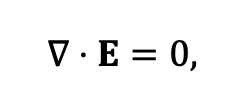
which contradicts Gauss’ law.
The origin of this contradiction lies in the assumption that the electric field cancels due to equal amounts of charge in all directions. Such cancellation would require contributions from arbitrarily distant charges to balance exactly at every point. In an infinite charge distribution this argument is not well defined because the total charge in any direction is itself infinite. As a result, the electric field cannot be determined through simple cancellation arguments.
The symmetry-based constructions considered in the previous section provide well-defined ways of extending the charge distribution to infinity in a physical way. When Gauss’ law is applied to these constructions, the electric field is nonzero and grows linearly with distance, with the proportionality constant determined by the symmetry used to construct the uniformly charged universe.
The apparent contradiction between Gauss’ law and the argument that the electric field vanishes everywhere arises when one assumes from the outset that the universe already contains an infinite amount of uniformly distributed charge. In that case the electric field at any point is often argued to vanish because equal amounts of charge exist in all directions, leading to cancellation of the field contributions.
However, this reasoning implicitly relies on cancellations between contributions from infinitely distant charges. Because the total amount of charge in every direction is itself infinite, these cancellations are not well defined. As a result, the conclusion that the electric field must vanish everywhere leads to an inconsistency with Gauss’ law, which requires

for a uniform non-zero charge density .
The constructions considered in this work avoid this difficulty by introducing infinity through a limiting process rather than assuming it from the outset. By extending the charge distribution while preserving a specified symmetry, the enclosed charge within a distance remains well defined at each stage of the construction. Gauss’ law can then be applied consistently, yielding electric fields whose magnitudes depend on the symmetry used to construct the uniformly charged universe.
This illustrates that the apparent breakdown of Gauss’ law occurs only when an infinite charge distribution is assumed from the beginning. When the distribution is constructed through a limiting procedure, Gauss’ law remains valid and produces well-defined electric fields.
5. A geometric interpretation
The three electric fields obtained above,

reflect the way charge accumulates with distance under different symmetry assumptions.
For spherical symmetry, the amount of charge enclosed within a distance r grows with the volume of a sphere,

For cylindrical symmetry, the enclosed charge grows with the cross-sectional area of the cylinder,

For planar symmetry, where the universe is constructed by stacking planes, the enclosed charge grows only linearly with distance,

Gauss’ law relates the electric field to the ratio of the enclosed charge to the area of the Gaussian surface. Because the enclosed charge grows with different powers of r, the resulting electric field takes the form

where n corresponds to the dimensionality of the symmetry used in constructing the distribution. For spherical, cylindrical, and planar constructions, n=3, n=2, and n=1, respectively.
Thus the coefficients 1/3, 1/2, and 1 arise naturally from the geometric scaling of charge accumulation with distance. The stronger electric fields obtained in the cylindrical and planar constructions therefore reflect the increasingly rapid accumulation of charge when larger elements of infinity are incorporated into the construction of the uniformly charged universe.
6. Conclusions
We have examined the application of Gauss’ law to a universe uniformly filled with charge by constructing the charge distribution while preserving different symmetries. When the distribution is built through spherical, cylindrical, or planar constructions, Gauss’ law yields electric fields

respectively. Although the charge density is identical in all three cases, the resulting electric fields differ because the amount of charge enclosed within a distance grows differently depending on the symmetry used to construct the distribution.
This analysis illustrates why the common argument that the electric field must vanish everywhere in a uniformly charged universe is not valid. That argument implicitly assumes a pre-existing infinite distribution of charge and relies on cancellations between contributions from infinitely distant charges. Because each of those contributions is itself infinite, the cancellation argument is not well defined and leads to an apparent conflict with Gauss’ law.
By instead introducing infinity through a limiting construction that preserves symmetry at every stage, the enclosed charge remains well defined, and Gauss’ law can be applied consistently. The resulting electric field reflects the symmetry used to extend the charge distribution to infinity. In this sense, the more infinity that is assumed a priori in the construction, the more charge is present within a given distance and the stronger the resulting electric field.
More generally, the coefficients obtained in the three cases arise from the geometric scaling of the enclosed charge with distance. For spherical, cylindrical, and planar constructions the enclosed charge grows as r cubed, r squared , and r, respectively, leading to the electric field scaling

with n=3, 2, 1. This example therefore provides a useful pedagogical illustration of how symmetry assumptions determine the electric field obtained from Gauss’ law and highlights the subtle role that infinity plays in arguments involving uniform charge distributions.
Acknowledgment
Thanks to Dr. David Joffe who stimulated this exploration.
References
Griffiths, D. J., Introduction to Electrodynamics, 5th ed. (Cambridge University Press, Cambridge, 2023).
Guisasola, J., Almudi, J. M., Salinas, J., Zuza, K., and Ceberio, M., “The Gauss law: Difficulties of learning electrostatics in undergraduate courses,” European Journal of Physics 29, 1005–1016 (2008).
Jackson, J. D., Classical Electrodynamics, 3rd ed. (Wiley, New York, 1999).
Purcell, E. M. and Morin, D. J., Electricity and Magnetism, 3rd ed. (Cambridge University Press, Cambridge, 2013).
Saini, S. S. and Kohandani, R., “Student understanding of Gauss’s law and symmetry arguments,” American Journal of Physics 93, 454–460 (2025).
Comments